
Golf Ball Compression Chart
Golf ball compression describes how much a ball deforms at impact. Enter your driver swing speed — or your typical carry distance if you do not know it — to see the compression range most often recommended for players like you, and learn what compression does and does not change about your game.
- Free to use
- No sign-up
- Runs in your browser
Quick answer
Use a golf ball compression chart as a starting point, not a rule. Match driver swing speed first: under 85 mph usually fits low to low-mid compression, 85–105 mph fits mid to mid-high, and over 105 mph often fits high compression. If you do not know swing speed, estimate it from driver carry by dividing carry yards by about 2.3.
Compression finder
Golf Ball Fitting & Practice Kit
Printable ball fitting test worksheet, club distance chart, swing speed and carry reference, and a practice session log.
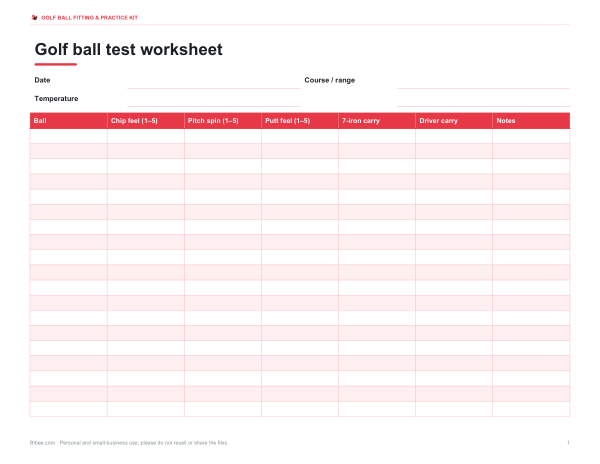
- Ball fitting worksheet (PDF, XLSX)
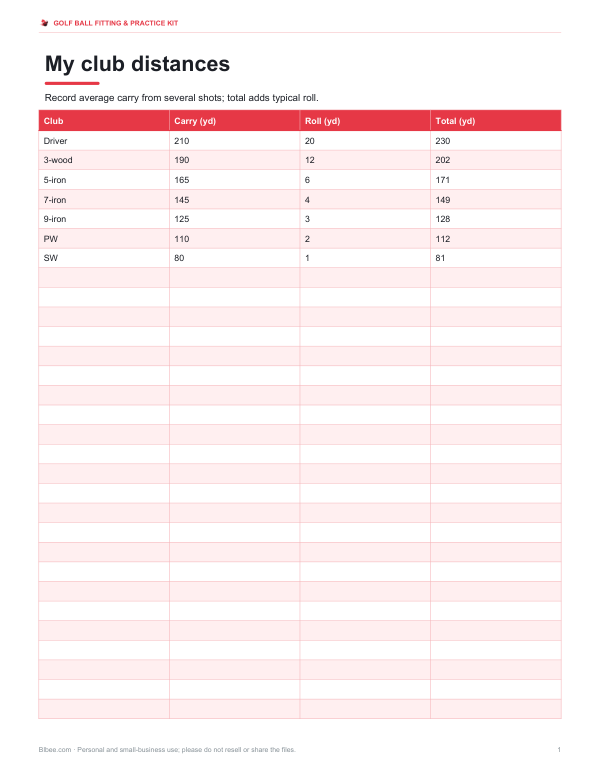
- Club distance chart (XLSX)
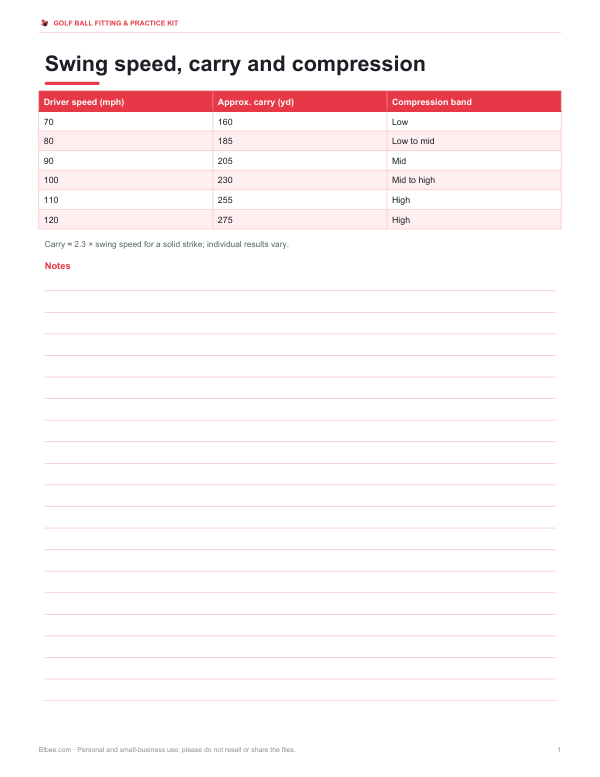
- Swing speed reference (PDF)
- Practice log (PDF, DOCX, XLSX)
Formats: PDF, XLSX, DOCX. Instant download after payment (link valid 72 hours, up to 5 downloads). AI-assisted: the templates were drafted with AI help and reviewed and laid out before publishing.
$5.00 USD, one-time 4 files · about $1.25 each
- Instant download
- 7-day refund
- Secure checkout by Stripe
7-day money-back guarantee. Full refund within 7 days of purchase, even after you download.
Free sample: Ball Fitting Test (PDF, 99 KB)
Full refund within 7 days — see the refund policy and license.
Free printables
Single sheets you can print right now, no sign-up. The full pack adds every sheet in one download plus the editable files.
 Printable Practice Log Sheet
Golf Ball Compression Chart
These ranges are common fitting starting points; exact compression numbers vary by brand and test method.
| Driver speed | Typical carry | Compression band | Typical rating |
|---|---|---|---|
| Below 75 mph (<121 km/h) | Under ~170 yd (~155 m) | Low | ~40–60 |
| 75–85 mph (121–137 km/h) | ~170–195 yd (155–178 m) | Low to mid | ~50–70 |
| 85–95 mph (137–153 km/h) | ~195–220 yd (178–201 m) | Mid | ~70–85 |
| 95–105 mph (153–169 km/h) | ~220–240 yd (201–219 m) | Mid to high | ~80–95 |
| Above 105 mph (>169 km/h) | Over ~240 yd (>219 m) | High | ~90–105+ |
What golf ball compression means
Compression is a measure of how much a golf ball deflects when a load is applied. The traditional scale, based on the Atti compression gauge, runs roughly from 0 to 200, with most modern balls rated somewhere between about 30 and 110. A lower number means a softer ball that squashes more at impact; a higher number means a firmer ball. Manufacturers do not all publish compression figures, and they do not all measure them the same way, so treat any published or tested compression numbers as approximate and compare balls from the same source.
Golf ball compression chart by swing speed
| Driver swing speed | Typical carry | Compression band | Typical rating |
|---|---|---|---|
| Below 75 mph | Under ~170 yards | Low | ~40–60 |
| 75–85 mph | ~170–195 yards | Low to mid | ~50–70 |
| 85–95 mph | ~195–220 yards | Mid | ~70–85 |
| 95–105 mph | ~220–240 yards | Mid to high | ~80–95 |
| Above 105 mph | Over ~240 yards | High | ~90–105+ |
This is a widely used rule of thumb. Carry estimates assume roughly 2.3 yards per mph of swing speed with a well-struck driver; your numbers depend on launch, spin and strike quality.
How to find your swing speed
- A launch monitor at a driving range, golf shop or fitting studio gives the most accurate number.
- Personal launch monitors and some swing sensors estimate speed at home or on the range.
- Without equipment, estimate from carry distance: divide your typical driver carry (not total with roll) by about 2.3.
- Average amateur male golfers are often quoted at around 90–95 mph with a driver; many women, seniors and juniors swing slower.
Does compression really matter?
Compression affects feel more than anything else. A ball that is too firm for a slow swing can feel hard off the face, especially on short shots and putts, while players with fast swings often find very soft balls feel mushy and can lose some control. Distance effects are real but usually modest; launch conditions, spin and fit of your clubs matter more. Many fitting experts recommend choosing a ball for how it performs around the green — where most shots are played — and then checking it goes far enough off the tee.
Compression vs cover material
| Feature | What it mainly affects |
|---|---|
| Compression (core firmness) | Feel at impact and, to a degree, ball speed and spin off the driver |
| Cover (urethane or ionomer/Surlyn) | Greenside spin, durability and feel on short shots |
| Construction (2-, 3-, 4-, 5-piece) | How spin and speed are tuned across different clubs |
| Dimple pattern | Flight, launch and stability in wind |
Premium “tour” balls usually have urethane covers and multi-layer construction, and many are mid to high compression; distance and soft-feel balls often have ionomer covers and lower compression. Low compression alone does not mean low quality.
Temperature and compression
Golf balls get firmer in cold weather and lose some ball speed. Players who regularly play in cold conditions often prefer a lower-compression ball than they would use in summer. Keep balls at room temperature before a cold round — a ball left in a freezing car will feel noticeably harder. The Rules of Golf do not allow warming a ball artificially during a round, so warm them before you start.
Worked example
A golfer carries the driver about 200 yards. Dividing by 2.3 gives an estimated swing speed of about 87 mph, which falls in the mid compression band (roughly 70–85). They play mostly in spring and autumn, so they try one ball near the low end of that range and one near the top. On the course, they compare feel on chips and putts, check distance with a mid-iron, and choose the ball whose short-game feel they prefer, since the difference off the tee is only a few yards.
How to test golf balls yourself
- Pick two or three balls in the suggested compression range, including one with a urethane cover.
- Start around the green: hit the same chips and pitches with each and note spin and feel.
- Putt with each ball; feel and sound matter to confidence.
- Hit several mid-irons and note height and distance.
- Finish with drivers, ideally with a launch monitor.
- Choose one ball and stick with it for consistency.
Myths about compression
- “Slow swingers must use low compression.” They often prefer it, but a firmer ball will not ruin their game.
- “Harder balls always go further.” Only if you can compress them efficiently; distance depends on launch and spin too.
- “Compression is printed on the box.” Some brands publish it, others describe feel instead, and numbers are not standardised.
- “Compression decides spin.” Cover material and construction play a bigger role, especially around the green.
Privacy
The calculator runs in your browser and does not store your numbers.
Frequently asked questions
How do I read a compression chart for golf balls?
Find your driver swing speed row first, then use the listed compression range as a shortlist. If you only know carry distance, divide carry yards by about 2.3 to estimate swing speed.
Are golf ball compression charts standardized?
No. Compression numbers are not measured or published the same way by every manufacturer, so treat them as approximate and compare numbers from the same source when possible.
Should cold weather change the compression I choose?
Often, yes. Golf balls feel firmer in cold weather, so many players move slightly lower in compression for rounds below about 55 °F (13 °C).
What compression golf ball should I use?
A common guide: low compression below about 85 mph swing speed, mid for about 85–105 mph, and high above 105 mph.
What is a low compression golf ball?
Generally a ball rated below about 70, designed for a soft feel and easy compression at slower speeds.
Does compression affect distance?
Somewhat, but launch, spin and strike quality matter more.
What is my swing speed if I hit the driver 220 yards?
Roughly 95 mph, using about 2.3 yards of carry per mph.
Are compression ratings the same across brands?
No. Measurement methods differ; compare within one source.
Does cold weather change compression?
Balls feel firmer and lose some speed in the cold.
Do old golf balls lose compression?
Balls stored for years in a cool, dry place perform close to new; balls left in heat or water for long periods can lose some performance.